
Tony Cragg
SCULPTURAL LANDSCAPE
Photo: Peter Lennby
In summer/autumn 2026, a generous selection of eleven sculptures by British/German Artist Tony Cragg can be seen at Pilane. The exhibition coincides with the Artist being awarded the prestigious 2026 European Culture Prize at the Royal Concertgebouw in Amsterdam on September 4.
There are soulful places that you won’t find unless you look for them. Far from the busy motorway and the bustling city life, Pilane offers a place for peace and contemplation. Nature and culture interact here. The large, well-reserved burial field from the Iron Age, nearby ancient hillforts and a varied and beautiful topography are unique to Pilane. This is a place with a view where we can look inwards. For a weightless moment, we are in a miniature Arcadia full of possibilities.
The rich and unpredictable quality of Tony Cragg’s aesthetic ideas is as astounding as the diversity of nature itself. And nature has been a constant source of inspiration for Cragg, who as a boy spend memorable years on his grandfather’s farm in southern England. The organic and the geometrical merge seamlessly in his evocative works.
Since the beginnings of his work in the early 1969, Tony Cragg has been on a ceaseless quest for new possibilities. His artistic urge is expressed in sculptural experiments with bronze, stone, wood, plastic, fibreglass, and other materials. It’s all about form, the essence of these materials, and surface treatment. His creative practice starts with a hint of something that wants to be conceived but does not yet know how. Here, the artistic process is one of patient listening. A forward movement that is both intuitive and consistently logical. The shapes do not evolve towards a representation of something that already exists, but develop to end ultimately in unplanned and unpredictable new forms. The creative urge does not act in opposition to common sense but follows its own strict logic, as if the decisions lay hidden in the material. Thus, Cragg’s art is born from inner structures. Sometimes out of a geometric figure and sometimes out of a more nebulous form, an inner pressure or a displacement. His sculptures deliver a response rather than a statement. As if the artist were discovering shapes that as yet have no defined language.
The artist’s gaze is often aimed downwards, to that which lies beneath our feet. Towards geology. To the layers that carry us. To sense the landscape, to understand how the ground shapes the life above — plants, animals, humans. Everything rests on the slow movements of matter. “Without material, there is nothing, material is all there is” Cragg repeats in interviews. That is where the essence lies: in that deep feeling that the material world is ultimately complicated and sublime. Every material has its own characteristics. Bronze is soft, pliant, easy to manipulate and has physical properties that lend themself to shaping. Steel is the opposite: hard, resistant, requiring industrial force and techniques to be processed. Different materials, different wills.
And yet, all Cragg’s sculptures hold a potential that is veritably choreographic. They are distinctly suspended between stillness and dynamism, between heft?? and flow. Forms unfold, unravel, billow and merge. As if the material itself were in motion.
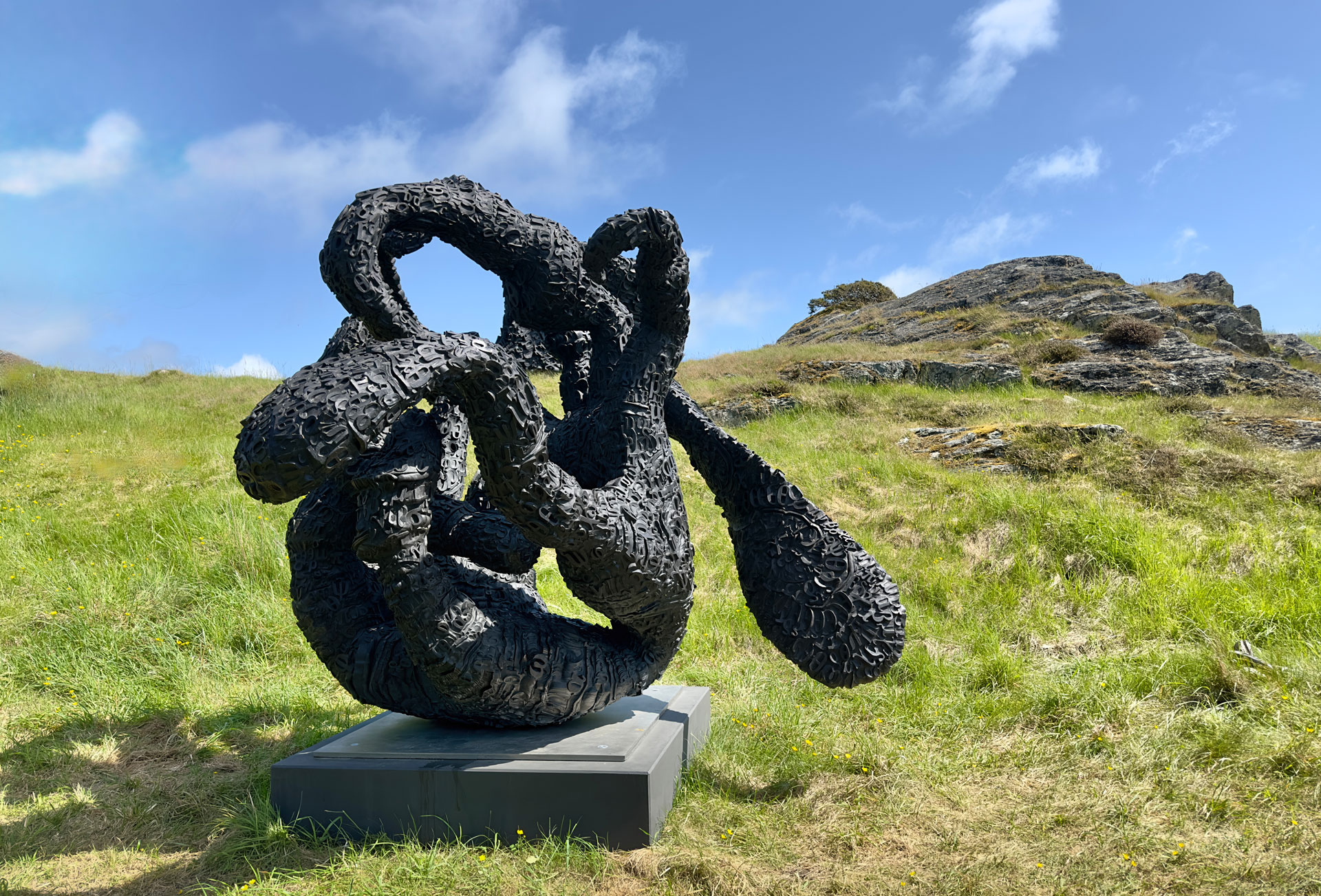
The mighty bronze sculpture Manipulation rom 2008 stands out against Cragg’s later works. Resembling hands that have become an autonomous creature, writhing free from their original form – out of defiance, lack, inner chaos. The fingers are splayed like wills. Each joint pulling in different directions, as though trying to break free from the grip they should hold. At close range, signs appear from the metal: Greek and Latin letters, trapped but impatient, pushing from within and out through the bronze surface. The core is charged – with a calm, indefatigable power, ready to burst, ready to be free.
Tony Cragg’s sculptures often seem to rotate around a deep core, as if holding on to an invisible axis. Ever After exists in several versions. In the 2010 version, now shown at Pilane, the focus is on the dynamics of the material — as though born from an intense, whirling centrifugal movement. The work harbours a tension between weight and speed: a heavy material nonetheless seeking to flow, ascending and descending, a form that appears almost organic, geological in its movement.
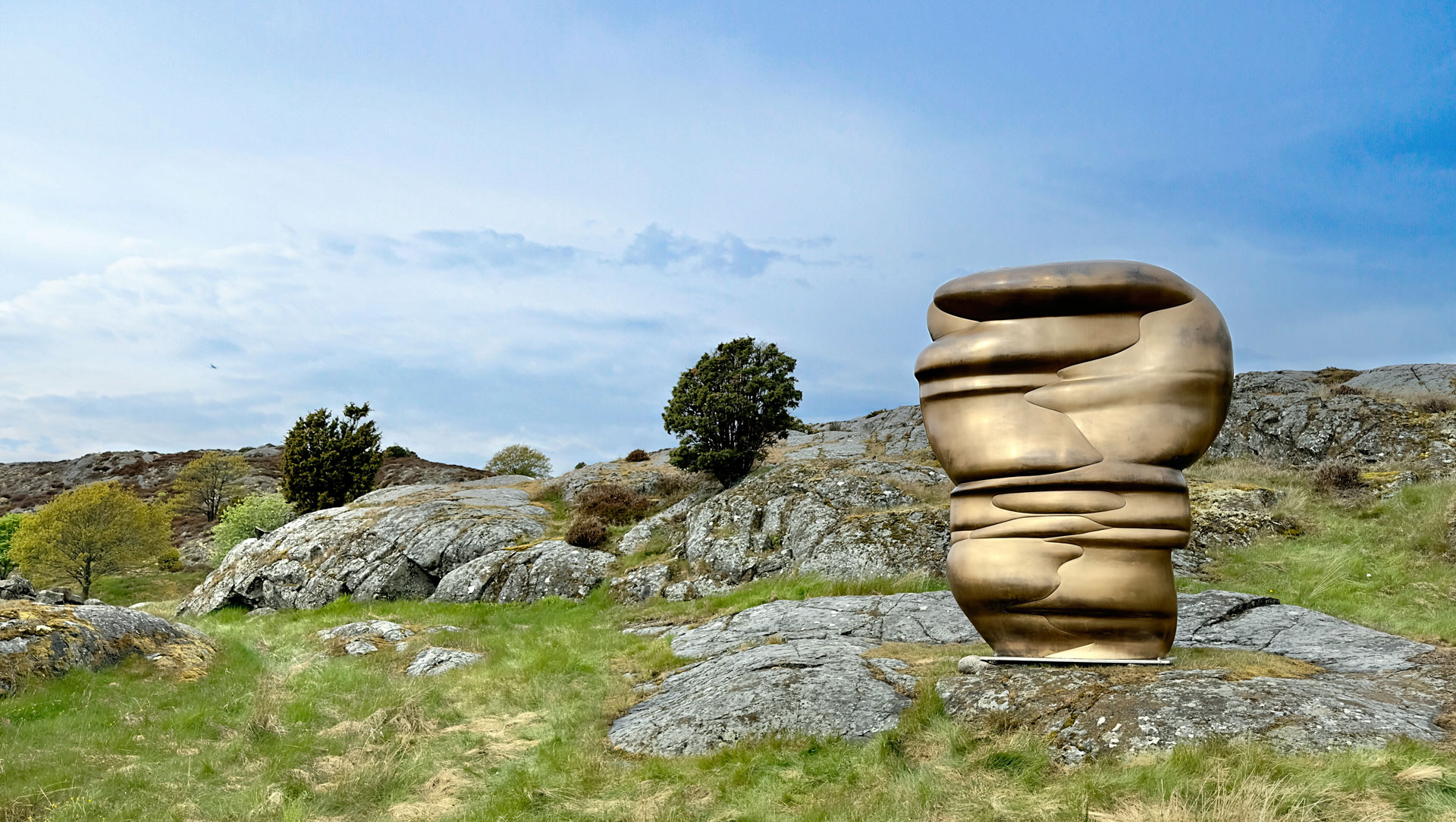
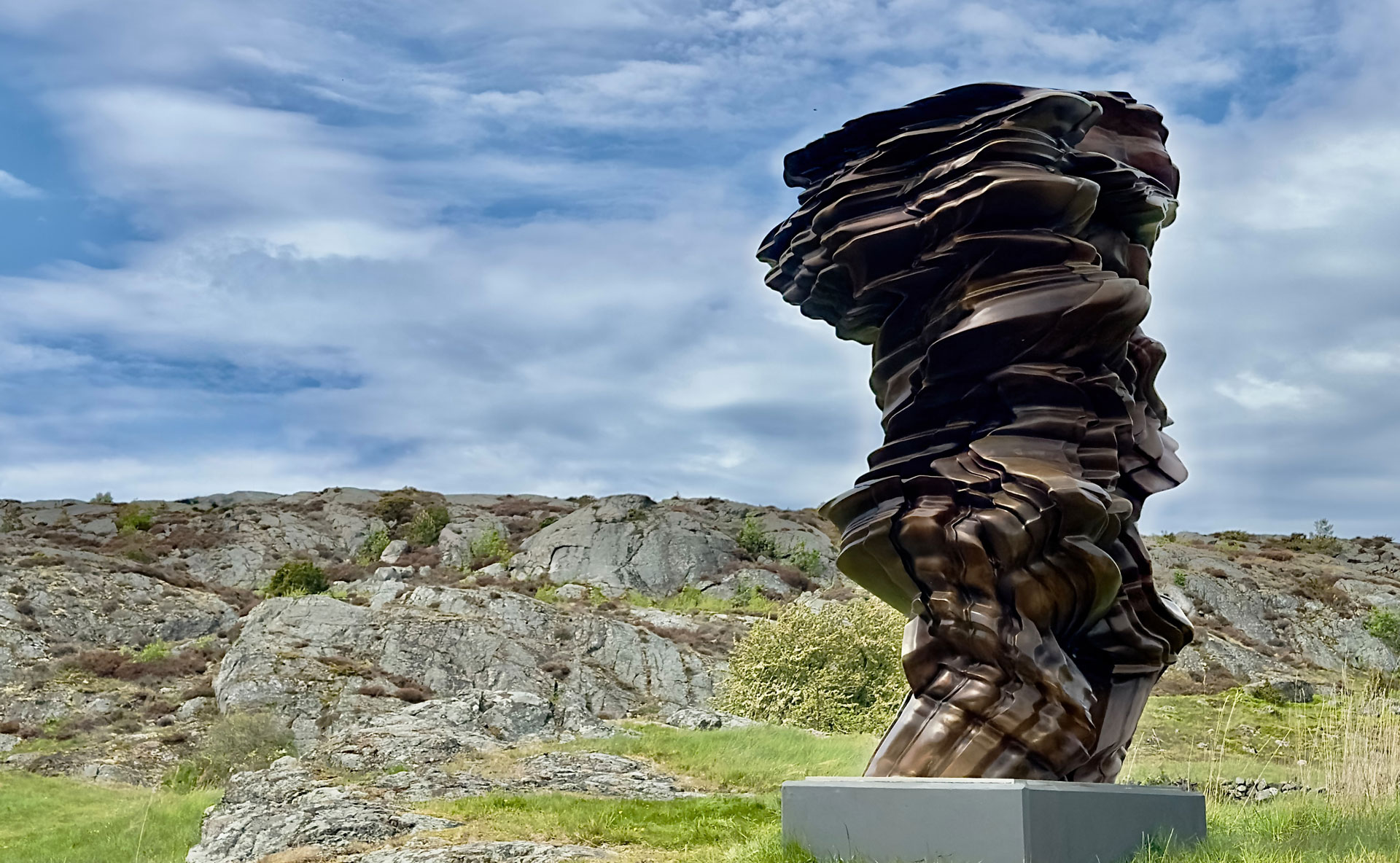
Masks is based on the interaction of two Janus masks, and consists of stacked, rounded layers that are pressed together, absorbed stretched, returned. They have traces of streaks and compression, like breath marks in the material. An unrelenting pulse runs through the entire sculpture, a rhythm that is characteristic of Tony Cragg’s works, but heightened to a near-organic intensity. Each work becomes a study in volume and scale, but also in time. The circular and elliptical sheets rise upwards, layer upon layer, as if the form were building its own geology. Out of this system, a massive but living body is born. Profiles of human faces overlap, gliding in and out of the contour, until the figuration dissolves and leaves a resonance: the face as an echo, a suggestion, a structure rather than an image.
And yet, it is instantly recognisable. The body makes itself known, not through distinct details but through its weight, balance, a sense of displacement. The sculptures combine power and vulnerability: they stand firm but seem to be heading somewhere, solid but with an inner flow, as if the material were about to alter into a different state.
In Masks, man is not depicted but shifted, transformed. The profiles are not portraits they just infer ubiquitous human presence. The form oscillates between familiarity and strangeness, between inner and outer, as if being of two worlds. The beholder meets something that defies being held: a figure that continues to shift with every new sightline, with the light playing on the surface, with its presence in the landscape.
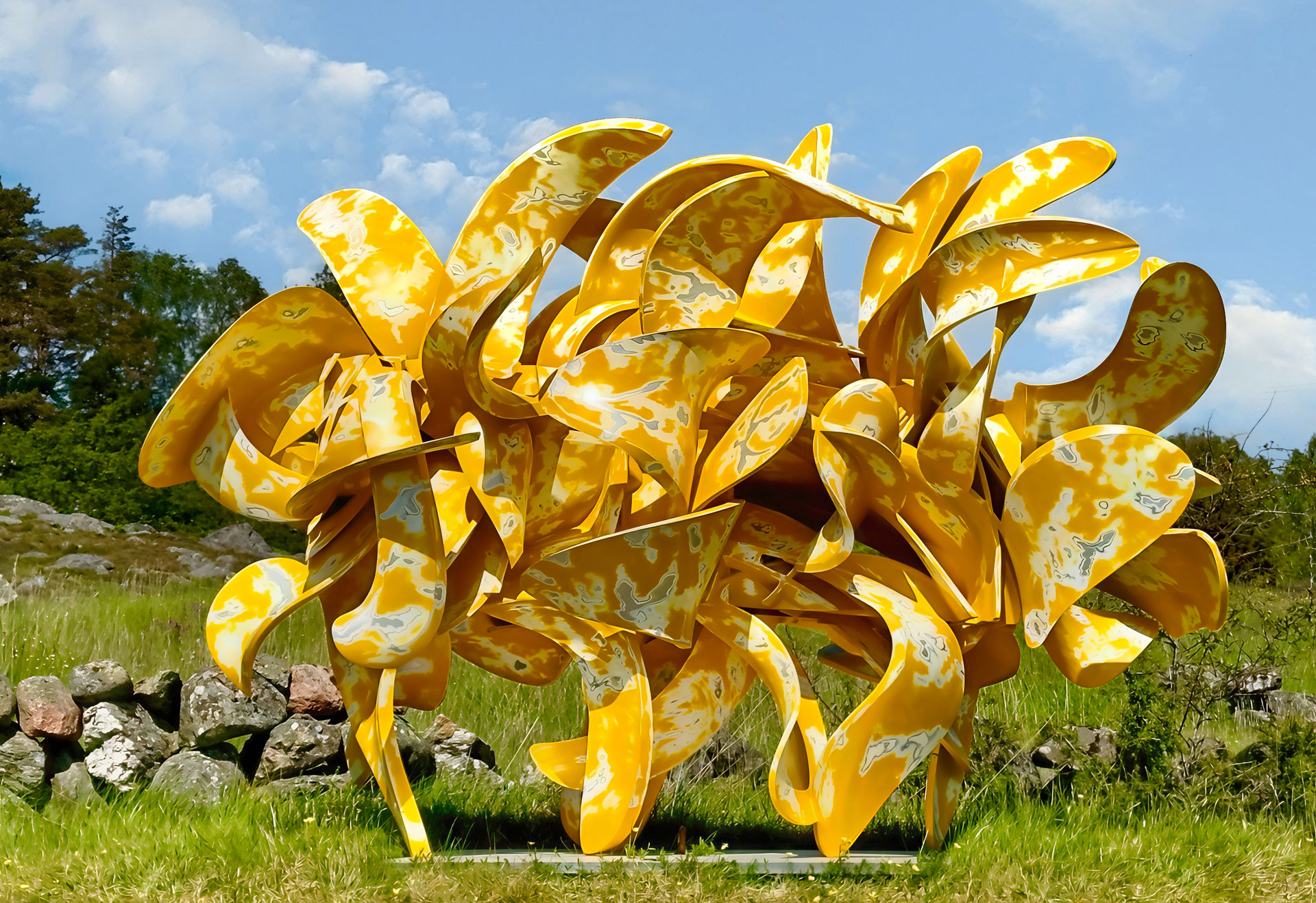
Industrial Nature belongs to a series of monumental sculptures in aluminium and bronze. Their shapes seem to grow, twist and stack up, as if by their own inherent logic rather than man’s. The surfaces are layered, unfold and close again, in a serene but intense motion, as if the sculpture were thinking with its body.
The abstract imagery vibrates with a subtle charge. Our gaze can lose itself in the billowing curves and dense structures. What lies within? Flowers about to blossom? Corals growing in the murky sea? Cells dividing, or the wing span of a gigantic butterfly? Are those petals — or propellers? Nature and technology mirror one another until the line between them dissolves.
The bright yellow pulsates across the surface, interrupted by patches where the paint has been sanded off, like signs of time, touch or erosion. Here, the surface is not a cover but a skin, marred by its own creation. The sculpture seems to breathe, despite its heaviness. But its vitality is paradoxical. The organic shapes are cast in stiff, industrial metals – materials imbued with ideas of control, durability and technological power. This contradiction embodies what Cragg describes as a collision, but also a potential fusion, between the organic and the artificial. The sculptures stand as frozen moments of growth, captured in the midst of a movement that was never completed.
Industrial Nature can be interpreted as a subtle yet distinct resistance to a world dominated by standardisation and sterile perfection. Instead of sleek surfaces and clear purposes, Cragg offers complexity, irregularities and openness. Here is a longing for material vitalism — a reminder that even the industrial can be infused with life, and that form can still be a place where nature and mankind meet, not in harmony, but in an ongoing, fruitful tension.
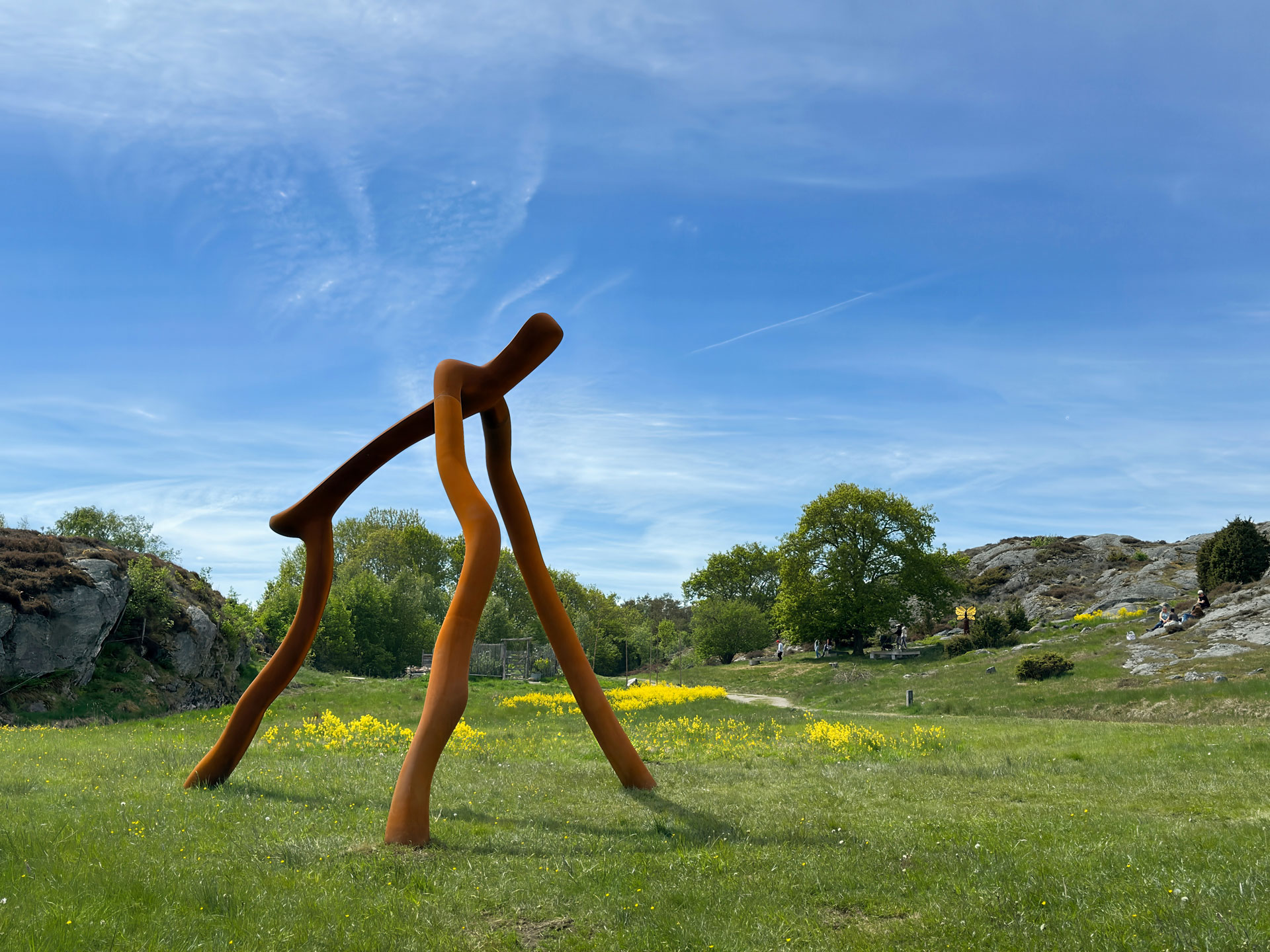
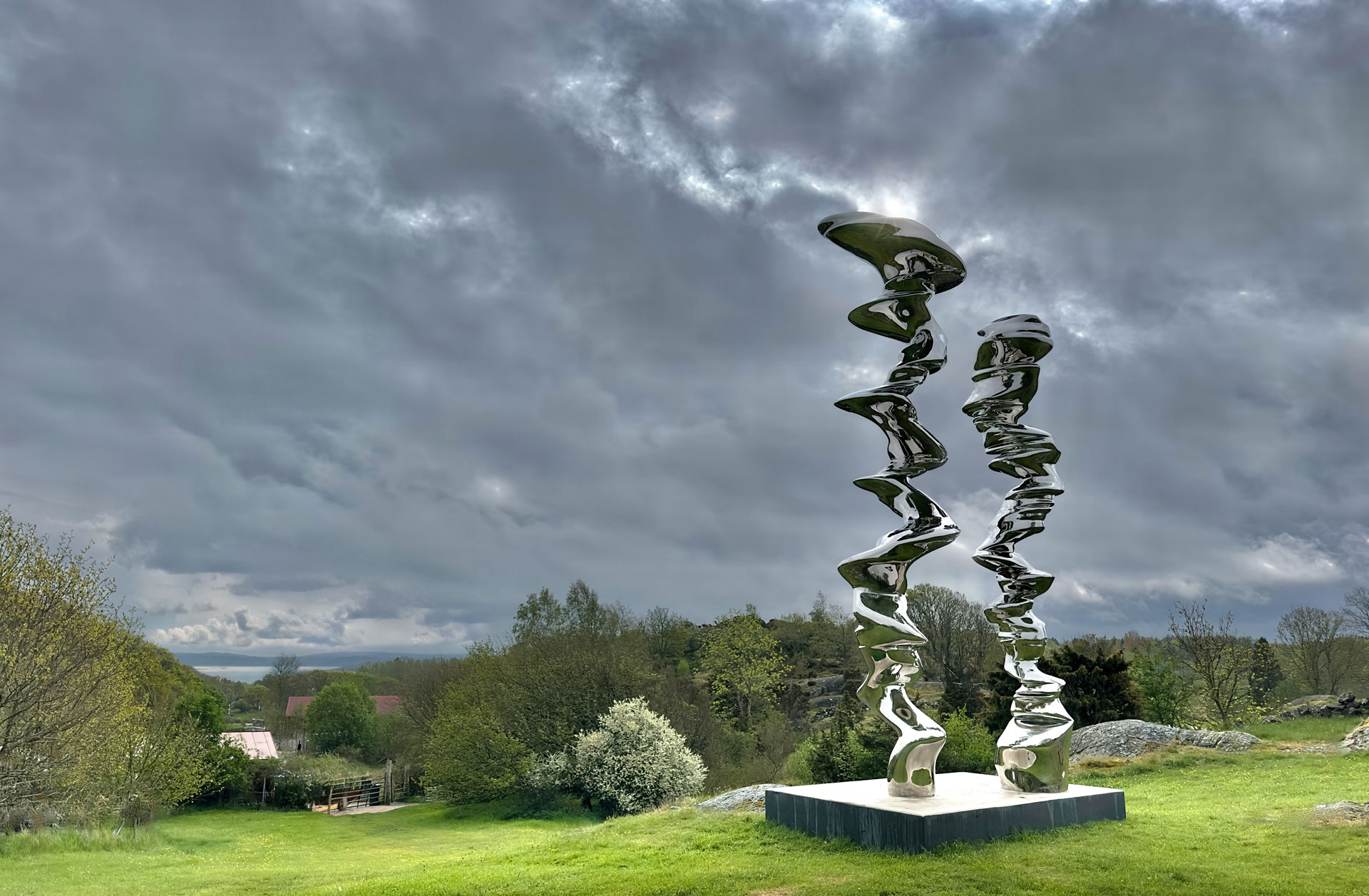
Dreamsleeper is part of a series of vertical, stick-like sculptures in corten steel or bronze. Unlike many other of his works, these structures are open and seemingly unstable. The spaces are as significant as the shapes themselves. The series was inspired by African neck rests, traditionally carved from wood branches — a bridge between nature’s coiling shapes and our need for support and rest. Similarly, Cragg’s work balances between shapes that were grown and sculpted.
This version of Dreamsleeper stands four and a half metres tall. Despite its size, there is something patently careful about its posture. The thin figure seems to step cautiously through Pilane’s varying landscape, as if listening to the ground it traverses. The sculpture combines strength and vulnerability in a form that is both unfamiliar and strangely vibrant.
Stack is one of Cragg’s most recurrent and iconic motifs. Here, the stacking provides a basic pulse. The shapes are layered on top of one another, like geological sediments or industrial relics. The series bears traces of industrialism’s rhythm — a legacy of order, repetition and construction – but also moves away from the strictly functional, towards something that resembles growing.
In Mean Average, made of fibre glass, the separate details rise from the stillness — gigantic, heavy, yet in motion. The shapes billow like wind-driven sand, like mountains slowly formed by time. Pillar-like volumes sweep upwards. In their surfaces we glimpse human faces. Warped profiles that appear, only to disintegrate and vanish.
The sculpture is constructed of layers — softly curved organic slices – as if the material has a memory of its own past. They resemble eroded cliffs, sediments that have settled over the millennia. Here, man merges with the landscape. Silhouettes arise from the mass, only to immediately be reabsorbed. The body is not separated from nature but is part of its eternal flow. The exhibition Sculptural Landscape holds a symbolic significance. It points to both the landscape shaped by nature itself, and that which is fashioned by human hands in nature, from the inherent will of materials and the imprint of time. The art here is also our very own voyage of discovery within ourselves. The works are never isolated but are consummated in the encounter with our life experiences, knowledge and receptiveness. Thus, Tony Cragg’s works are more like mental states for experiencing rather than objects to behold. The sculptures resist all hurry. They sing the praise of slowness and reach for eternity.
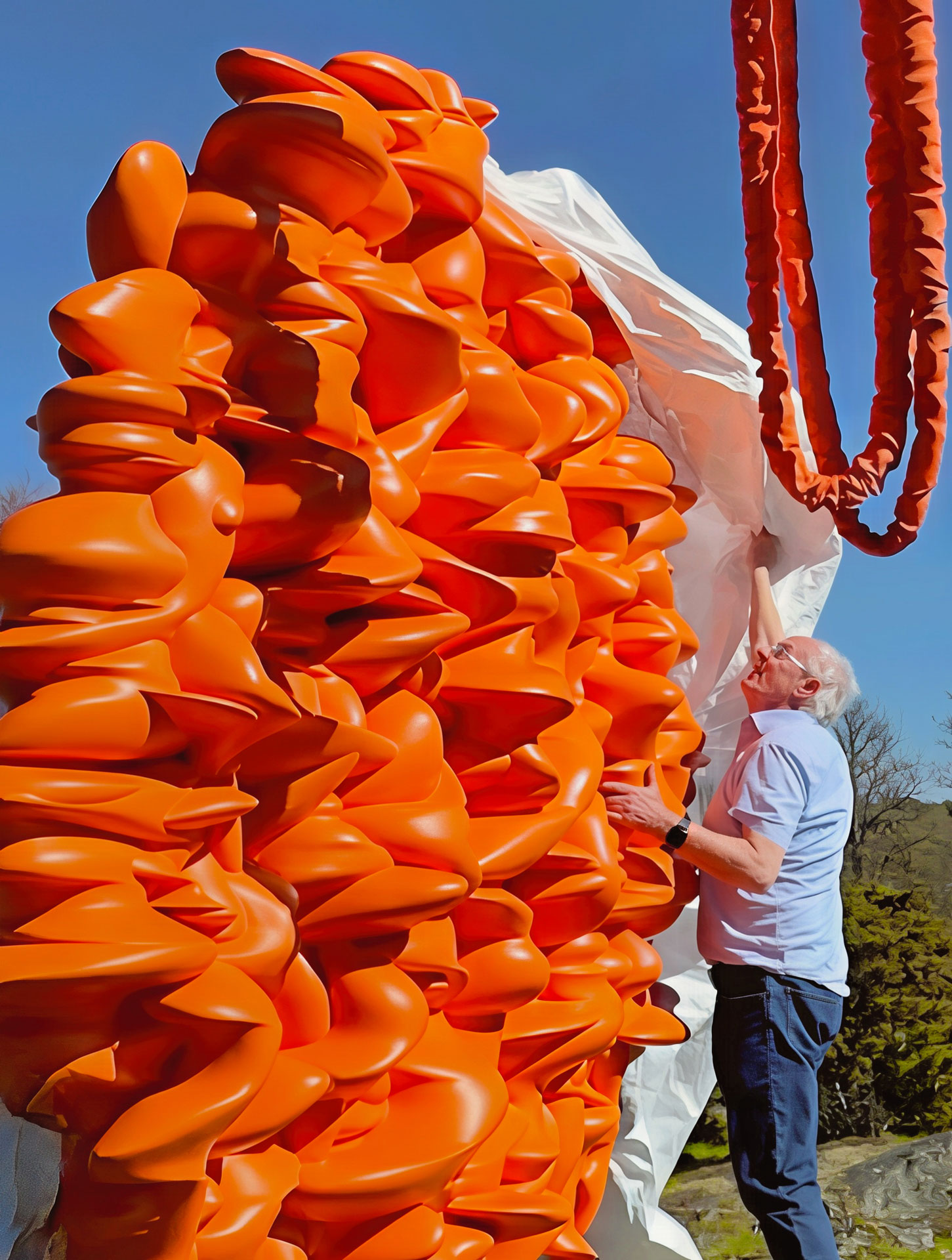
Tony Cragg, born in Liverpool in 1949, is one of the world’s best known sculptors. He studied at the Gloucester College of Art and Design in Cheltenham in 1968—1969, at the Wimbledon School of art in 1969—1972, and at the Royal College of Art in 1972—1977. He has been based in Wuppertal, Germany, since 1977. In the summer, he works in his studio on Tjörn in Bohuslän. Tony Cragg was awarded the Turner Prize in 1988 and in 2007 he was awarded the Premium Imperalie. He is a member of the Royal Academy of Arts in the UK since 1994. His works have been exhibited extensively all over the world and can be seen in many public places.
On the 4th May till mid-July Tony Cragg’s works can be seen at Cá Thron in Venice in his one-man exhibition there, Oceans of Drops. And, 6th May till 28th June 2026, Tony Cragg also participates in a group exhibition, Waves, an exhibition at Casa Sanlorenzo, in conjunction with the Venice Biennale that explores waves as a universal visual metaphor for movement and transformation in art and science.